

For most Houston homes, game truck space requirements come down to a single number: about 60 feet of solid, level parking. That’s the truck and the trailer together, still hitched.
Search this question, though, and the answers scatter. One company says 50 feet. Another says 55. A third says 60. Not one explains why they disagree — and not one tells you what happens to your deposit if the truck turns up and can’t park.
Both are worth knowing before you pay anybody. Checking your own space takes about five minutes, and it’s the one part of planning a game truck party you can verify yourself, for free, without talking to a salesperson.
Where these numbers come from
The 60-foot figure and the surface rule below come from our own published policies, not an estimate. The comparisons to other companies come from their own websites, checked in September 2026.
One thing worth saying plainly: we could not find a single Houston game truck company that publishes its space or power requirements anywhere on its site. The only operators we found publishing real figures are in Kentucky and California. If you’ve been struggling to get a straight answer locally, that’s why.
How Much Space Does a Game Truck Need?
| What you need | Figure | Why it matters |
|---|---|---|
| Length | About 60 feet | Truck and trailer together, still connected |
| Width | Roughly 15 feet | Trailer body, door swing, and a path for kids to walk |
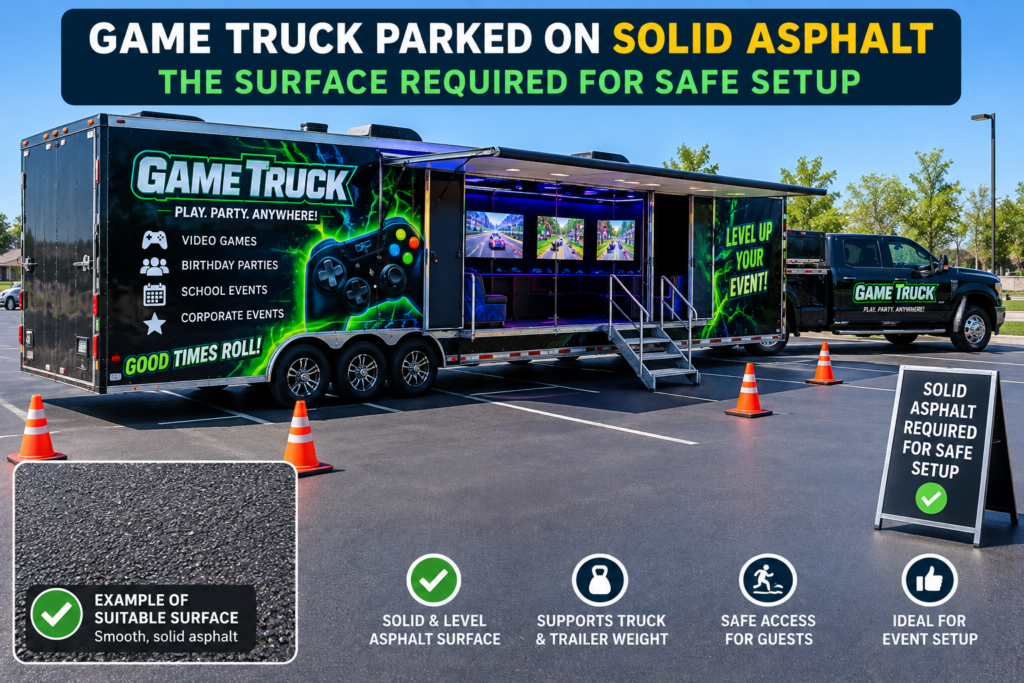
| Surface | Concrete, asphalt or firm gravel | Not lawn, not dirt, not soft shoulder |
| Slope | As level as you can find | People move around inside while it’s parked |
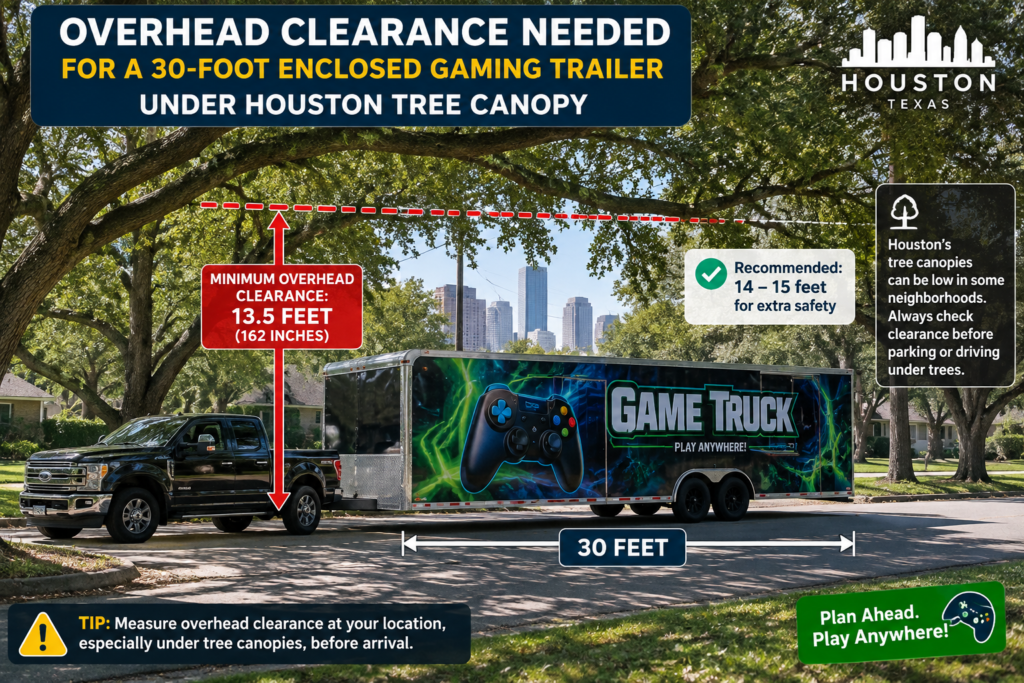
| Overhead | Clear of branches and low lines | An enclosed trailer is tall |
Sixty feet is about four mid-size cars parked bumper to bumper. Go outside and pace it. Eyeballing a street is unreliable in a way that pacing it isn’t — most people underestimate by ten or fifteen feet, and the gap between “looks fine” and “fits” is exactly where the problems live.
Why every company quotes a different number
The spread isn’t carelessness. Two things drive it, and once you know them the numbers stop looking random.
Trailer length. Mobile gaming trailers run from about 20 feet to 30 feet. A company towing a 20-footer honestly needs less room than one towing a 30-footer.
Whether the driver unhooks. Some operators detach the trailer on arrival and park the truck down the road, so they only need space for the trailer itself. Others keep the rig hitched for the whole event. One operator we found states outright that it doesn’t unhook — which is exactly why its published figure sits higher than a company that does.
Between them, those two variables are why published game truck space requirements swing by ten feet across companies serving the same city. So when you’re comparing, one question isn’t enough. Ask: “How much space do you need, and do you unhook the trailer?” Those two answers together tell you whether your street works. A 55-foot requirement from a company that unhooks and a 55-foot requirement from one that doesn’t are not the same requirement at all.
Game Truck Parking Requirements: Surface, Width and Clearance
Length is the figure everyone publishes. It’s also the one that fails least often. Here’s what actually goes wrong on the day.
The surface rule nobody publishes
We park on concrete, asphalt or compacted gravel. Not lawns. Not dirt. Not that soft strip where the grass meets the curb.
This isn’t fussiness, and it’s worth understanding why. A loaded trailer on wet Houston turf sinks. It leaves ruts that cost real money to put right, and every so often it doesn’t come out without help. After a wet week in spring — which is most weeks in spring — ground that looks perfectly firm often isn’t, because the top inch dries and the rest doesn’t.
If a company offers to park on your lawn to make a booking work, understand what’s happening: they’re moving the risk onto your yard and your wallet. We won’t do it, and it’s worth being wary of anyone who will.

Width is half the problem
Sixty feet of length on a narrow street with cars parked opposite isn’t 60 feet of usable space. Allow roughly 15 feet of width — the trailer body, plus the door swinging open, plus a safe path for children walking in and out.
There’s a simple test for this, and it works better than a tape measure: could a garbage truck still get past while we’re parked there? If the answer’s no, then neither could an ambulance, and that becomes your neighbors’ problem before it becomes ours.
Look up before you book
An enclosed 30-foot trailer is tall, and nobody in this industry mentions it.
Low tree limbs and sagging utility lines are everywhere in Houston’s older neighborhoods — stretches of the Heights, Meyerland, Sharpstown and plenty of established Sugar Land streets have canopy that closes right over the road. Stand where you’d want the truck and look straight up. If a moving van would clip it, so will we.
This one catches people out because it’s invisible at eye level. The street looks wide open. The problem is fifteen feet above it.
Room to arrive isn’t the same as room to park
Here’s the distinction that trips up more Houston bookings than any other: space to sit and space to get in and out of are different things.
Anyone who moves large vehicles for a living will tell you the same thing — commercial parking guidance treats maneuvering room as a separate calculation from the parking space itself, and for good reason. A game truck is smaller than a freight rig, but it still needs a way in and a way out, not just a slot to occupy.
This is why cul-de-sacs are the single most common reason a booking has to move. Picture a typical newer Katy or Cypress subdivision: the bulb has 60 feet of curb, easily. But there’s a truck in one driveway, a boat trailer in another, and no room at all to swing a long rig around and get back out. The length was never the issue.
If you’re on a cul-de-sac, send a photo. It’s genuinely hard to judge from a description, and it’s the situation where a two-minute check saves a real problem.
Game Truck Power Requirements: The Industry’s Most Contradicted Question
Search this and you’ll find flatly opposite answers.
One national operator that serves Houston states in its own booking guide that customers “provide absolutely nothing” — every trailer arrives with an onboard generator. A rental listing from an operator in California requires a 110-volt outlet on a 20-amp breaker, a 30-amp RV plug if you want the air conditioning running, or a $215 generator rental if you have neither.
Both are describing their own equipment accurately. Neither mentions that the other approach exists. So somebody reads the first page, assumes it’s how the industry works, books a different company, and finds out on a Saturday afternoon that they needed an outlet nobody told them about.
Ask every company you call the same two questions: do you bring your own power, and if I’m supplying it, what exactly do you need? Write the answer down. It’s the cheapest insurance in this whole process.
For our trucks, we carry backup power, and we’ll confirm exactly what your location needs when you book. Worth having ready either way:
- Roughly where your nearest exterior outlet is
- Whether it’s a standard household outlet or something heavier
- What else will be drawing on that circuit during the party
Why air conditioning is the real load in Houston
Screens and consoles don’t draw much. Screens and consoles plus climate control in August is a different proposition, and that combination is what trips breakers.
Climate control isn’t a nice-to-have here — it’s most of the reason a game truck works in this city at all. A sealed trailer in a Houston July without air conditioning isn’t an entertainment venue, it’s a hazard. That’s why every truck we run is climate-controlled, and why the power conversation matters more here than almost anywhere else. Two minutes on the phone beats a dead trailer at 2pm with twenty kids waiting.
Where Game Trucks Can’t Park in Houston
Most of these are solvable with one phone call two weeks out. All of them are worse discovered on the day.
- Apartment and townhome complexes. Nearly always need management approval, and often a certificate of insurance from the operator. Property managers are rarely difficult about this — they’re just rarely fast. Start two weeks ahead, not two days.
- HOA restrictions. A number of Sugar Land, Pearland and Missouri City associations restrict commercial vehicles on residential streets, temporary ones included. Check your covenants or call a board member. Five minutes now beats an argument in the middle of your daughter’s birthday.
- Tight cul-de-sacs. Covered above. Length won’t save you if there’s no turning room.
- Streets with parking on both sides. Common in older inner-loop neighborhoods. If a couple of neighbors would need to move cars, ask them in advance — most people are happy to, and nobody enjoys being asked at short notice on a Saturday morning.
- Gated communities. The rig needs to clear the gate, and the gate needs to stay open long enough for 60 feet of vehicle. Tell the guardhouse the day before.
- School and church lots. Worth saying clearly: these are the easiest venues, not the hardest. Wide, flat, paved and usually empty at weekends. If your street won’t work, this is the first place to look.
What If Your Space Doesn’t Work?
You’ve got options, and this is the part other pages skip entirely — most of them assume the space works and quietly lose everyone it doesn’t.
- A neighbor’s wider frontage. Often the entire fix, and usually a five-minute conversation over the fence.
- The nearest school, church or community center lot. Wide, paved, generally free at weekends with permission.
- A park with paved parking. Check whether your city requires a permit for a commercial vehicle first.
- A relative’s street. Plenty of Houston parties happen three miles from the birthday kid’s house for exactly this reason, and no child has ever minded.
Send us a photo of where you’d want the truck when you ask for a quote. We’ll tell you honestly whether it fits — including when the answer’s no, and where nearby would work better. You can see the full footprint in our gallery if you’d rather judge it yourself first.
What Happens to Your Deposit If the Truck Can’t Park?
Nobody in this industry publishes an answer to this. We’re going to, because it’s the question a careful parent is actually turning over.
Every game truck company in Houston takes a deposit, and most — ours included — are non-refundable. Ours is $100 down, balance due seven days before the event, a $100 cancellation fee once payment is in, and $50 to move a date. Those terms are firm, and they’re set out in full on our policies page.
Which means the real risk here isn’t the space. It’s finding out the space doesn’t work after the money’s committed.
That’s why we’d rather sort it out before you pay a cent. Tell us the address, describe where you’re thinking, and send a photo if there’s any doubt at all. If a driver decides a spot isn’t safe, it doesn’t get used — that’s a safety line rather than a preference, and it sits alongside the rest of how we handle safety. Nobody wants that conversation happening at the curb while the party’s already started.
Whoever you end up booking, ask it directly: “If your driver arrives and decides my space won’t work, what happens to my deposit?” The answer matters. So does how comfortably they give it.
Your Five-Minute Space Check
Do this before you pay a deposit to anyone.
- Pace 60 feet where you’d want the truck — roughly four cars bumper to bumper.
- Check the width. Could a garbage truck still get past?
- Check the surface. Concrete, asphalt or firm gravel. Not grass.
- Look up. Branches, wires, anything a moving van would hit.
- Check the approach. Can a long rig get in and back out without a three-point turn?
- Check the slope. Noticeably sloped? Mention it when you book.
- Check the rules. HOA, apartment management, gate access.
- Take a photo and send it with your inquiry.
Seven out of eight fine and one uncertain? Call anyway. Nearly all of these have workarounds. The one that usually doesn’t is a genuinely tight cul-de-sac — and even then, there’s normally a school lot within a mile.
Frequently Asked Questions
How much space does a game truck need?
About 60 feet of length and roughly 15 feet of width, on a solid and reasonably level surface. That covers a truck and trailer still hitched together. Companies towing shorter trailers, or that unhook on arrival, may need less — ask both questions when you compare quotes.
Can a game truck park in my driveway?
Usually not. Most residential driveways are too short, too narrow, or slope toward the street. Curb frontage in front of the house is the normal answer, or a nearby lot if the street is tight.
Do I need to provide electricity for a game truck?
It depends entirely on the operator, and this is the most contradicted point in the industry. Some carry an onboard generator and need nothing from you. Others need a standard 110-volt outlet, or a heavier 30-amp connection if air conditioning is running. Ask before you book. We bring backup power and confirm the specifics for your address.
Can a game truck park on grass?
No. Concrete, asphalt or compacted gravel only. Loaded trailers sink into soft ground, leave ruts that are expensive to repair, and can get genuinely stuck — especially after Houston rain.
What if my street is a cul-de-sac?
It depends on the size of the bulb. A cul-de-sac can have plenty of length and still not work, because there’s nowhere to turn a long rig around. Send a photo and we’ll tell you before you book rather than after.
Do I need permission from my HOA or apartment complex?
Often, yes. Several Sugar Land, Pearland and Missouri City associations restrict commercial vehicles, and most apartment complexes want management approval — sometimes with a certificate of insurance. Allow two weeks.
How long before the party does the truck arrive?
We’ll confirm an arrival window when you book so the truck is set up and ready before your guests are. Worth asking any company whether your booked hours start on arrival or at first play — the answer isn’t the same everywhere.
What happens if it rains?
Light rain is a non-event; the trailer is enclosed and climate-controlled, which is much of why game trucks work in Houston at all. Flooding, lightning and tropical systems mean a reschedule. Soft, waterlogged ground can also rule out a spot that was perfectly fine the week before.
More answers are on our FAQ page.
Check Your Space Before You Book
Game truck space requirements aren’t complicated: 60 feet, solid ground, and a clear way in and back out. They’re just rarely published, which is why so many people find out the hard way. It’s the one part of this you can confirm yourself, in five minutes, before spending anything.
So don’t guess and hope. Call or text (281) 923-5923 with your address, or send a photo of where you’d want the truck parked. We’ll give you a straight answer — and if your spot won’t work, we’ll help you find one nearby that will.
Ready to go? Book your date, or see what a party costs on our pricing page. También tenemos información en español.
About the author
Sahib S. Easley owns and operates The Game Truck, a family-run mobile gaming company in Sugar Land, Texas, formerly known as Lisa’s Rolling Video Games. He started it in memory of his mother, Lisa “Mona” Easley, who spent years welcoming anywhere from two to twenty neighborhood kids into her basement to play video games — that story is here. The parking, power and weather guidance on this page comes from running events across Houston, not from research. Questions: (281) 923-5923.